

🙂 Introduction
Friends, does this ever happen to you as well… that every single night before going to bed, we firmly decide that we are definitely going to wake up early tomorrow! We even set an alarm on our mobile phones.
But in the morning, the moment that alarm rings, we get so irritated that we angrily turn it off, pull the blanket over our head, and go right back to a peaceful sleep? This must surely be happening to you too, right? If your answer is ‘yes,’ then don’t worry at all—you are not alone!
A few months ago, the exact same thing used to happen to me every single day. Every morning, I used to feel so lazy and tired that just getting out of bed to take a simple shower or brush my teeth felt like moving a mountain. But tell me, why does this happen to us even after getting a full 7 to 8 hours of sleep that our body needs?
Perhaps you might be thinking, “We work so hard all day, go to our jobs, and rush around, that’s why we feel this tired.” But just think about it, our grandparents used to do double or triple the physical hard work in their generation compared to us.
They didn’t even get to sleep peacefully for as long as we do! Yet, they never used to feel so completely drained out. Then, even after getting such deep and full sleep, why are we the ones who remain tired and sluggish throughout the day?
The meaning of this is absolutely clear—the reason behind this daily fatigue is definitely not just work stress! Behind this laziness, some tiny but serious mistakes happening unknowingly in our daily lifestyle are also responsible.
And today in this blog, we are going to discover those exact hidden reasons and some very simple, easy home remedies for them.
Just like I personally benefited a lot from these simple remedies and got my lost energy back, I hope the same happens for you too. With this exact hope, today we are going to discuss this topic together. So, let’s get started!
🤔 Is This Fatigue Normal or Serious? Check These 5 Signs of Constant Fatigue
Friends, when our body’s battery is completely down, it starts giving us some small ‘signals’ from the outside. If something like this is happening to you every single day, then understand that your fatigue is no longer just normal laziness:
- 1. Zero Focus on Work: Imagine you have opened your laptop or started some household chores… but your mind goes completely blank. Even though the work is right in front of you, it feels like your concentration and focus have completely vanished. A simple task that you can usually finish in 10 minutes takes hours to complete.
- 2. Intense Irritation (The Mood Swings): When there is absolutely no energy left in the body, it directly affects our behavior. There is an unknown stress in the head, you don’t understand what to do, and then you instantly get angry at the person in front of you, family members, or even on very petty things. Later we feel that we got angry for no reason, but at that exact moment, we have no control over our mood.
- 3. Not Even Feeling Like Moving: So much laziness and heaviness fill up the body that just getting up from your place feels like the hardest job in the world. The mind constantly pulls you back, and from within, there is only one desire—“That’s it, don’t do anything now… just lie down peacefully in one place on the couch or bed.”
- 4. The Endless Yawns: You are sitting quietly in one place, not doing any physical hard work; yet, one after another, continuous yawns just keep coming. Tears come out of your eyes, but the yawning just doesn’t stop. This is nothing but a living warning that your brain is running low on oxygen due to increased bodily fatigue.
- 5. Constantly Wanting to Sleep: When we get this kind of extreme fatigue, our mind and body constantly expect only one thing—peaceful rest! Well, at such times, you even get bored of your mobile or screen; you don’t feel like doing anything else at all, and you don’t even want to look at your phone. From within, only one voice comes, “I am so tired, let’s just go and take a quiet sleep!”
🔍 4 Hidden Reasons Behind Your Constant Fatigue (With Simple Science)
Friends, let’s talk about those daily habits that we do unknowingly, which completely drain our body’s energy:
1. Late Night Mobile Scrolling (The Midnight Scrolling Trap)
What Exactly is the Scientific Reason?
A harmful Blue Light comes out from our mobile screens, which hits our face and eyes directly in the dark. Often, the moment we take the phone in our hands, we start feeling drowsy and sleepy. But according to science, that sleep is not deep at all! This blue light completely confuses our brain, making it believe that it is still morning or daytime outside.
Due to this wrong signal, the body fails to produce Melatonin (the sleep hormone). That is why the peaceful, deep sleep you get without using a phone is completely missing here. Instead, you only get a half-broken, shallow sleep. This is exactly why, even if you stay in bed for 8 hours, your body wakes up feeling completely drained instead of being fully recharged.
What Mistake Do We Make?
Every night before sleeping, many times we don’t get sleep instantly. At that moment, we casually pick up our mobile phone. We think of checking it for just 5 minutes, but while scrolling through social media reels or posts, we don’t even realize when 1 or 2 hours just fly away.
Because of this, our 7 to 8 hours of essential deep sleep is not complete. As a result, when the alarm rings the next morning, our body does not feel fresh at all, and we feel lazy, tired, and sluggish throughout the day.

2. Sitting or Lying Down in One Place for Long Hours (The Energy Freeze)
What Mistake Do We Make?
Friends, whenever we feel lazy or tired, what do we usually do? We quietly go and lie down on the bed or couch and stay in that one place for hours. We think that taking rest will cure our tiredness, but the exact opposite happens!
The more time we spend lying down inactive in one place, the more our laziness increases instead of going away. We keep getting continuous yawns, feel like sleeping even more, and because of this, our whole body feels extremely heavy.
Especially after lunch, many people have a habit of sleeping immediately. This not only increases the chances of weight gain, but it also makes the body completely sluggish. On the other hand, if we don’t sleep immediately after eating and instead do just a little movement or take a short walk, we feel much fresher and lighter.
What Exactly is the Scientific Reason?
Science has a very simple rule—“The more you move, the more energy your body creates.” When we stay lying down inactive in one place just because we feel tired, our body’s metabolism slows down and our blood circulation drops.
Because of this, enough oxygen does not reach our brain and cells. Due to low oxygen, the brain continuously sends us yawning signals and makes the body even lazier. This is exactly why we keep feeling tired.
Understand One Important Thing (Normal Fatigue vs. Daily Fatigue):
We must definitely understand one crucial thing here. Imagine you worked a lot on a particular day, ran around, and that is why you are feeling tired today; then that is just normal work stress and tiredness. In such a situation, you can absolutely sleep and rest without any worry.
But… if you are getting this kind of tiredness every single day without doing any heavy work, then this is not normal. Behind this, there could be those serious mistakes in your lifestyle that we discussed above, which need to be understood in time.
3. Drinking Less Water & Too Much Tea/Coffee (The Caffeine & Sugar Crash Illusion)
What Exactly is the Scientific Reason?
Whenever we feel tired or lazy during the day, what is the first thing we do? We instantly go and drink a nice, strong cup of tea or coffee. We think our tiredness will just fly away! While having tea or coffee makes us feel fresh temporarily, within just a few hours, we feel completely drained out again.
The main reason behind this is that we drink tea and coffee to feel fresh, but what our body actually needs the most is drinking water. However, we completely ignore drinking water. Not drinking enough water throughout the day causes dehydration, which is the biggest reason behind constant fatigue.
What Mistake Do We Make?
Tea and coffee contain Caffeine. When caffeine enters the body, it does not actually remove your tiredness; it simply blocks the chemicals in your brain that signal fatigue. In short, tea just tricks your brain!
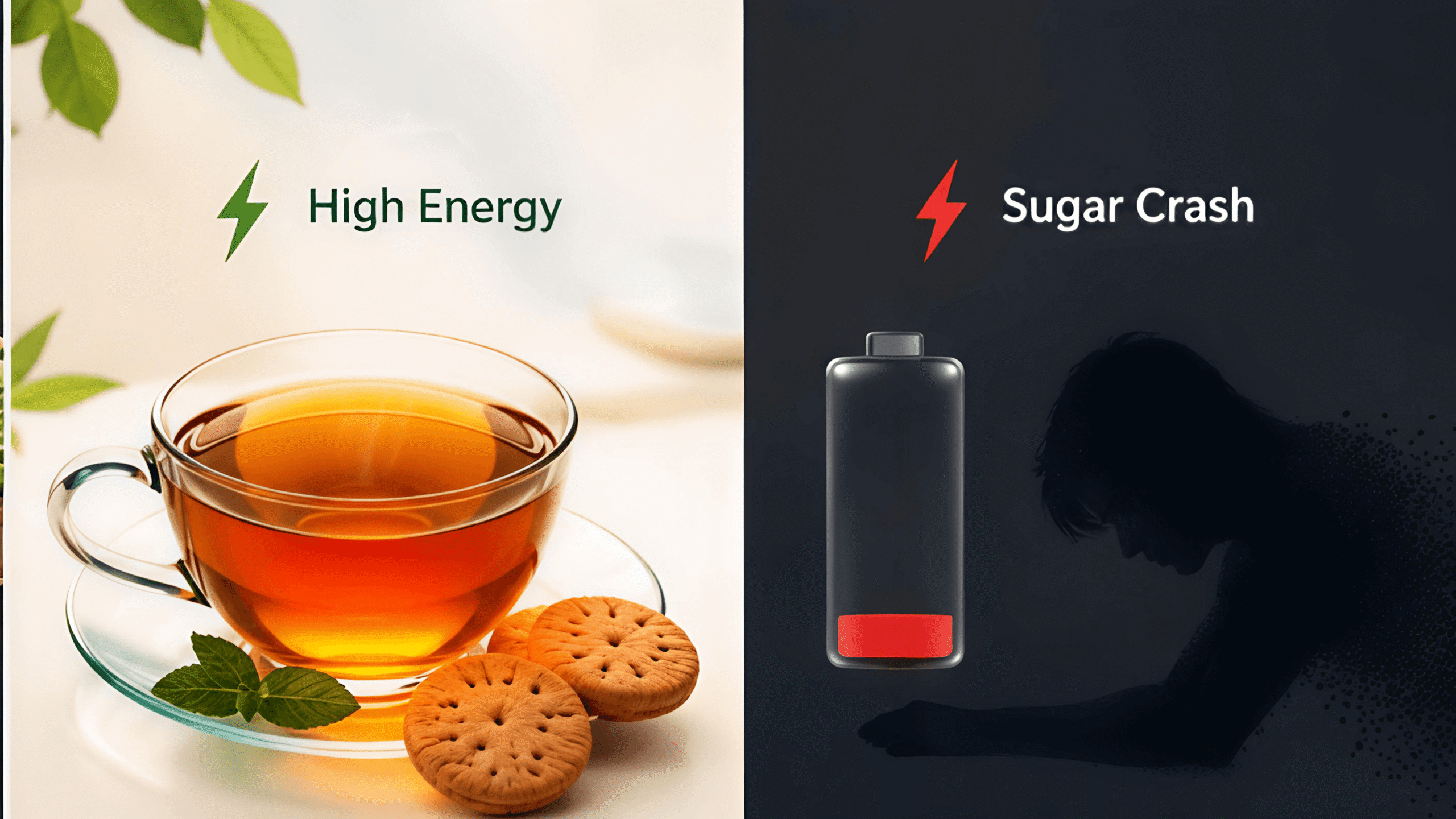
Another major factor is the sugar present in our tea and coffee, which causes a sudden spike in our blood sugar levels. This gives us an instant burst of energy. However, within just 1 or 2 hours, this sugar level crashes down just as fast, which science calls a Sugar Crash.
When this sugar crash happens, your body feels completely exhausted. On the other hand, our body is made of 70% water. Therefore, drinking less water slows down blood circulation, and your brain doesn’t get enough oxygen. That is why, instead of tea or coffee, drinking water gives oxygen to your cells and beats fatigue naturally.
| High Sugar/Caffeine Intake ▼ Rapid Blood Sugar Spike(Temporary Rush) ▼ Massive Insulin Release ▼ Sudden Blood Sugar Crash ➔ Severe Fatigue & Intense Cravings |
💡 Pro-Tip for Better Health:
Tea/Coffee often leads to digestive issues and energy crashes. To understand your gut health better, read our expert-curated guide: 🥗 Best Foods for Gut Health: 10 Top Foods to Support a Healthy Digestive System
4. Mental Stress and Overthinking (The Brain Energy Drain)
What Mistake Do We Make?
Friends, do you know what mistake we actually make? Many times, it so happens that we haven’t done any hard physical work or running around throughout the day. Yet, by the evening, we feel completely drained out. There is absolutely no energy left in the body. At that moment, we wonder, “I didn’t do any work today, then why am I feeling so tired?”
The answer to this is not in your body, but it is hidden inside your head! All day long, knowingly or unknowingly, we keep stressing about office work, worrying about the future, or overthinking about petty things for hours. This mental stress drains our energy much more than physical labor, which we completely ignore.
What Exactly is the Scientific Reason?
According to science, when we think too much, take tension, or are under mental pressure, our brain produces a stress hormone called Cortisol in large amounts. This cortisol hormone absorbs all the energy of our body from the inside. Our brain alone uses a massive 20% of the body’s total energy.
Therefore, when you overthink, your brain burns energy at twice the speed. This is exactly why, even without doing any physical work, a person gets completely exhausted just by overthinking.
5. Lack of Essential Vitamins in the Body (Nutrient Deficiencies)
What Mistake Do We Make or What Do We Ignore?
Friends, many times our sleep is completely full, we drink enough water, and we don’t even sit in one place; yet, we feel like there is no energy in our body throughout the day.
At that time we think, “Hey, I am doing everything right, then why am I feeling so tired?” Here we forget a very big thing—the essential fuel needed to run our body from the inside, which is Vitamins and Minerals!
In today’s fast-paced lifestyle and eating habits, our body does not get the daily nutrients it requires. We completely ignore these internal needs of our body, which later becomes a major reason for constant fatigue.
What Exactly is the Scientific Reason?
According to science, certain vitamins play a very important role in producing energy in our body. If there is a deficiency of the following things in your body, you can feel tired 24 hours a day:
- Vitamin D3: Vitamin D gives strength to our bones and creates energy in our cells. We barely go out in the sunlight all day, so nowadays almost everyone has a huge deficiency of Vitamin D, which increases body pain and laziness.
- Vitamin B12: This vitamin is the most crucial for creating red blood cells and energy in our body. Therefore, when there is a deficiency of Vitamin B12, the body loses its strength, and the mind goes completely blank.
- Iron and Calcium: Due to iron deficiency, hemoglobin in the blood decreases, because of which oxygen does not reach the brain properly and causes constant fatigue. Also, low calcium makes bones and muscles very weak.
🤗 5 Simple and Effective Remedies to Beat Fatigue
If you are tired of feeling exhausted all day, these simple lifestyle remedies will help you recover your lost energy. You don’t need any complex treatments; just a few small changes in your daily routine can make a massive difference.
Let’s look at these highly effective solutions that will drive away your laziness and keep you fresh from morning to night!
1. ‘Gadget-Free’ Night Sleep (The 30-Minute Screen Rule)
Friends, at least 30 minutes before going to bed, turn off your mobile phone completely and keep it in another room. If you don’t feel sleepy right away when you hit the bed, instead of picking up your phone, just start reading your favorite book.
While reading, you won’t even realize when you start feeling drowsy and fall into a deep sleep.Replacing your phone with a book will transform your shallow, broken sleep into a peaceful and restful night’s sleep.
This will complete your required rest, drive away all morning laziness, and keep you feeling energetic and fresh all day long.
🤔 Feeling sluggish in the morning?
Your morning routine might be the secret energy drainer you didn’t know about. Don’t let your day start on a low note—check this out: 🌅 5 Morning Habits That Secretly Drain Your Energy
2. The Power of Water (The Smart Hydration Routine)
Friends, many times we simply forget to drink water throughout the day. A very easy home remedy for this is—as soon as you wake up in the morning, fill up 3 to 4 water bottles at home! Whichever room you sit in at home, or wherever you go outside, always keep a water bottle with you.
Seeing the bottle right in front of your eyes reminds you to drink water, and this habit sticks with you permanently. Most importantly, if you want to keep both your skin and body healthy, drinking 1 to 2 glasses of water right after waking up is extremely necessary.
This keeps you hydrated for a longer time and naturally helps in reducing your constant fatigue.
3. Controlling Tea and Coffee (The 4-Sip Tea Formula)
Now coming to the topic of tea, I will never say that you should stop drinking tea completely. I myself drink tea only twice a day. But I have a specific rule—my cup contains only 4 to 5 sips of tea! Tea should only be taken to satisfy your craving and to get a temporary feeling of freshness.
Some people drink entire big glasses or huge cups of tea, please do not do that at all. Having just 4 to 5 sips of tea between 8 AM in the morning and 4 to 5 PM in the evening is more than enough. But remember, completely avoid drinking tea or coffee after evening.
If you follow this, your habit of drinking too much tea and coffee will naturally reduce, and you will feel completely fresh and energetic.
4. Move Your Body & Take a Walk (The 10-Minute Movement Fix)
Friends, many of us have a common habit—whenever we are free, we immediately lie down on the bed! We eat something and sleep right away, or finish a small task and just hit the bed. Now, if it is hard physical labor or fieldwork, taking rest makes sense because your body has already done enough movement.
But for those whose job involves sitting in one place for hours—whether it is men working on laptops in offices or women managing work from home—you should strictly avoid going straight to bed after sitting for so long. Instead, the moment you finish your work, just stand up and walk around for 10 minutes.
Whenever you feel bored or tired in the middle of your work, get up from your seat and walk a little. Because of sitting for hours, our muscles already become lazy and stiff, so if we sleep immediately, we feel even more sluggish. If you move a bit after work, those stiff muscles instantly shift into active mode.
I experience this myself! For people who have lots of work throughout the day and zero time to sleep, this is the absolute best solution. When you do this, you won’t even feel like sleeping anymore. Just a short walk will make you feel instantly fresh and energetic.
5. Smart Diet and Instant Energy Drinks (Fuel Your Body Right)
Friends, whenever you suddenly feel a lot of weakness or fatigue, it is extremely important to consume foods and drinks that give your body an instant energy boost. In such times, instead of drinking store-bought chemical energy drinks, always go for fresh lemon juice made right at home. Drinking fresh lemon juice reduces weakness very quickly.
Apart from this, you can also have fresh apple juice or orange juice. You must have noticed that doctors always recommend apples and oranges to hospital patients, simply because these fruits give an instant dose of strength to the body and drive away fatigue in a flash.
Along with these instant energy drinks, making small changes to your daily meals is equally necessary. Strictly avoid eating very heavy, oily, greasy, or refined flour foods (like fast food) during lunch or dinner. Such heavy meals overload your stomach and bring a massive wave of laziness right after eating.
On the other hand, if you include green leafy vegetables, sprouted grains, dry fruits (like almonds and walnuts), and buttermilk in your daily healthy diet, these natural foods will give your body genuine and long-lasting energy to stay active all day long.
🩺 When to See a Doctor?
When Should You Take It Seriously?
Friends, please try all the remedies we discussed above (like keeping your phone away, drinking enough water, cutting down on tea-coffee, and eating a healthy diet) honestly for about 2 to 3 weeks.
If your fatigue does not reduce at all even after making these lifestyle changes, or if it keeps increasing day by day, then please do not ignore it. In such a situation, instead of just trying home remedies, the smartest decision is to go straight to a doctor and get yourself checked.
What Warning Signs Mean You Need to See a Doctor Right Away?
Along with constant tiredness, if you experience any of the following symptoms, it is time to seek medical advice immediately:
- Sudden Weight Loss: If you are losing weight very rapidly without making any changes to your diet or routine.
- Constant Mild Fever: If your body constantly feels warm or you have a low-grade fever along with fatigue.
- Chest Pain or Shortness of Breath: If you struggle to breathe even after walking a little, or feel a heavy pressure on your chest.
- Severe Anxiety or Depression: If tiredness makes it impossible to focus on any work, and you constantly feel irritated, sad, or hopeless.
Friends, sometimes a constant feeling of tiredness can be due to internal health issues like anemia (low blood count), thyroid problems, or other hidden deficiencies. So, when your body is showing these warning signs, do not just depend on home remedies. Go to a doctor and get a simple blood test done.
❓ Frequently Asked Questions (FAQ)
Friends, along with these simple remedies, you might still have a few questions in your mind. Let’s look at some of the most common questions people ask about fatigue and get their quick, easy answers right here!
Q1. Why is it important to drink water instead of tea or coffee right after waking up?
Answer: Friends, since we don’t drink water for 6 to 8 hours while sleeping, our body gets slightly dehydrated in the morning. Drinking strong tea or coffee on an empty stomach triggers acidity and actually makes you feel more tired.
Instead, if you drink 1 to 2 glasses of water right after waking up, it drives away your morning laziness in a flash, improves blood circulation, and gives you natural energy that lasts all day.
Q2. Does keeping the mobile phone in another room really improve sleep quality?
Answer: Yes, absolutely! When your phone is right next to you, you are always tempted to check notifications. Watching screens before bed keeps your brain awake. But when you keep your phone in another room and pick up your favorite book, your eyes and mind naturally start feeling heavy.
Replacing your screen with a book helps you fall into a deep sleep, ensuring you wake up without any morning laziness.
Q3. What is the benefit of having only 4 to 5 sips of tea?
Answer: Many of us drink huge cups of tea whenever we feel tired. However, the high sugar in tea causes a temporary spike in energy, followed by a sudden drop called a Sugar Crash, making you feel even more exhausted later.
Tea should only be taken to satisfy a craving. When you limit it to just 4 to 5 sips, you get that quick feeling of freshness without shocking your body with excess sugar and caffeine.
Q4. Why do I feel more tired if I lie down on the bed immediately after laptop work?
Answer: Sitting in one place for hours makes your muscles lazy and stiff. If you hit the bed right after finishing your work, your body locks into that laziness, making you feel completely sluggish.
On the other hand, if you take a short 10-minute walk, those stiff muscles immediately shift into active mode, beating the exhaustion and making you feel instantly active.
Q5. What is the best home solution if I suddenly feel extreme weakness or fatigue?
Answer: Whenever you experience sudden weakness, instead of rushing to buy chemical energy drinks, always drink fresh lemon juice made at home. Lemon juice gives an instant energy boost to the body.
Along with this, you can have fresh apple or orange juice. These natural drinks provide an immediate dose of strength and drive away fatigue in a flash.
🔗 Conclusion

Friends, in today’s fast-paced life, feeling constantly tired has become a very common problem for almost everyone. But remember one thing—everyone’s fatigue and the reason behind it can be completely different! Some people feel exhausted from sitting in front of a laptop for hours, while others feel sluggish because of poor sleep or bad tea-coffee habits.
So, just look closely at your daily routine to find out what is causing your laziness, and try out the remedies mentioned above that fit your lifestyle best. You will easily figure out which trick is working like magic for your body in just two to three weeks!
Now, tell me, after reading all this, which remedy did you like the most, and which one are you starting today? Let me know by dropping a comment below!
Also, don’t forget to share this blog with that close friend or family member who always complains about feeling tired, so they can get some real help too.
For more amazing, practical, and healthy lifestyle blogs just like this one, make sure to follow me right away. And yes, please tell me in the comments what topic you want me to cover in my next blog!
Until then, take good care of your health, stay happy… and I will see you soon in the next exciting blog! Bye-bye! 👋😊✨
⚠️ Disclaimer
Friends, all the information and tips shared in this blog are purely for general knowledge and educational purposes only. I am not a doctor or a medical professional. Everyone’s body type and causes of fatigue can be different.
Therefore, always consult your doctor or a qualified healthcare expert before making any major changes or for any serious health concerns.
I also get tired immediately, try this solution of yours
Thank you for your positive response ❤️